Application notes

Scientific Poster – Skin sensitization and safety assessment based on an in vitro 3D vascularized fully differentiated immunocompetent skin model

SCIENTIFIC POSTER DOWLOAD —
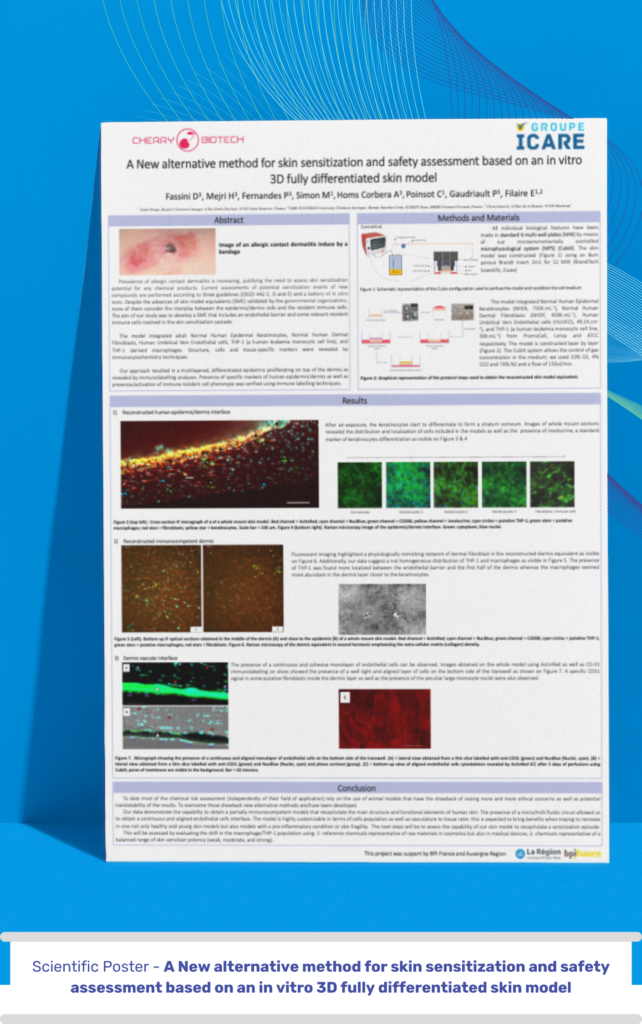
Skin sensitization and safety assessment based on an in vitro 3D vascularized fully differentiated immunocompetent skin model

Fassini D, Mejri H, Fernandes P, Simon M, Homs Corbera A, Poinsot C, Gaudriault P, Filaire E

With the rising prevalence of allergic contact dermatitis, accurately assessing the skin sensitization potential of chemical products is increasingly critical. Current methods, guided by three OECD guidelines and a set of in vitro tests, have advanced with skin model equivalents (SMEs). However, these models lack the crucial interaction between epidermis/dermis cells and resident immune cells, a key factor in skin sensitization.

Our study aimed to develop an SME that encompasses an endothelial barrier and relevant resident immune cells, enhancing the understanding of skin sensitization processes. We integrated adult Normal Human Epidermal Keratinocytes, Normal Human Dermal Fibroblasts, Human Umbilical Vein Endothelial Cells, THP-1 cells, and THP-1 derived macrophages into our model.

This innovative approach led to a multi-layered, differentiated epidermis that proliferates atop the dermis, as confirmed by immunolabelling analyses. Our model also successfully verified the presence and activation of specific human epidermis/dermis markers and resident immune cell phenotypes, offering a more comprehensive method for skin sensitization and safety assessment.

The poster, title: A New alternative method for skin sensitization and safety assessment based on an in vitro 3D fully differentiated skin model – is free to download here. Don’t miss out!
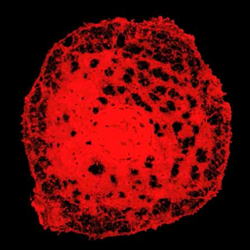
Cherry Biotech-Poster-Skin-sensitization-in-vitro-3D-differentiated-skin-model

How to culture vascularized & immunocompetent 3D models in a standard Multiwell

Related Posts

Table comparing 3D liver cell models and their best uses. Rows: HepG2 spheroids: high scalability/HTS-ready, greater structural resistance, shift to quiescent tissue-like state; optimal for early HTS (acute cytotoxicity). HepaRG spheroids: high, stable CYP activity with robust induction; metabolically superior to HepG2; optimal for early–mid HTS (metabolism/DDI screening). PHH spheroids: gold-standard metabolic fidelity and weeks-long functional longevity; best correlation with in vivo CYP induction; optimal for late preclinical de-risking (chronic DILI, MoA).
From 2D to 3D: Restoring in vitro liver models functions...
In our previous article, we outlined the main in vitro liver models, immortalized cell lines such as HepG2 and HepaRG, alongside primary hep...
Read more
Organ-on-a-Chip: A New Paradigm for Drug Development...
Introduction Organ-on-a-Chip is a potential, multidisciplinary method for in-vitro modeling of disease, drug screening, and precision medici...
Read more
Schematic of adipose tissue–breast cancer crosstalk: obese adipose tissue secretes adipokines and lipids, drives cancer cell growth and therapy resistance, and forms CAAs.
Adipose tissue and breast cancer: decoding proximal crosstalk in ...
Introduction Adipose tissue-breast cancer crosstalk is emerging as a key driver of tumor initiation, progression, and therapy resistance, li...
Read more

get in touch

Get the best insights about Cherry Biotech by Email Let’s stay in touch!
As part of our commercial prospecting, we may need to process your personal data. For more information, please consult our Privacy Policy
×

Our Associated Solutions

Banner

Need to generate real life like preclinical data with complex biological models?

Discover Cubix - Platform and Service
×

Contact Us!

Aside

We're happy to answer any questions you may have. Reach out to our team for assistance.

Contact Now