Application notes

Scientific Poster – in vitro human vascularized immunocompetent metastatic melanoma-on-chip model

SCIENTIFIC POSTER DOWLOAD —
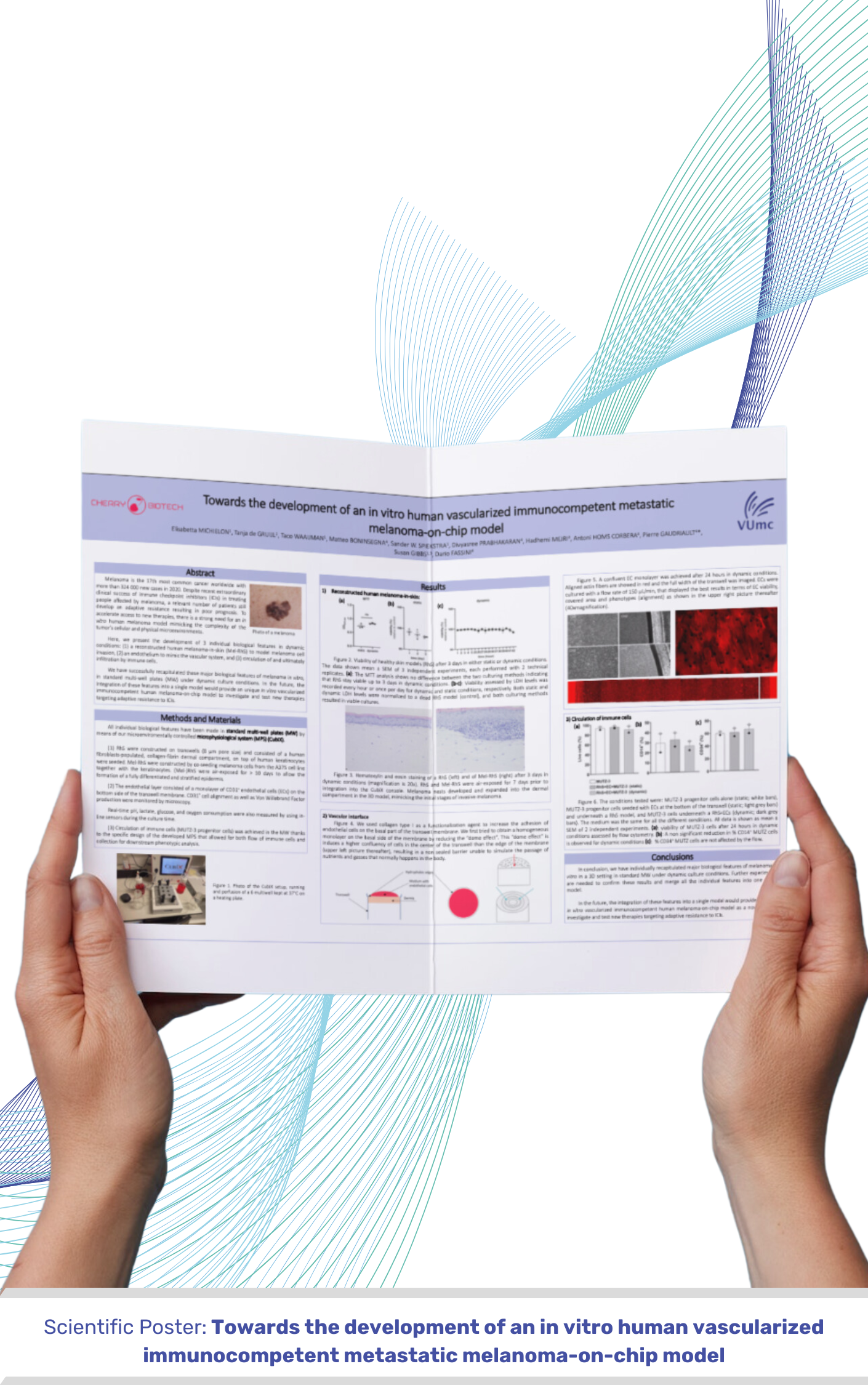
Towards the development of an in vitro human vascularized immunocompetent metastatic melanoma-on-chip model

Elisabetta MICHIELON, Tanja de GRUIJL, Taco WAAIJMAN, Matteo BONINSEGNA, Sander W. SPIEKSTRA, Divyasree PRABHAKARAN, Hadhemi MEJRI, Antoni HOMS CORBERA, Pierre GAUDRIAULT, Susan GIBBS, Dario FASSINI

Melanoma ranks as the 17th most common cancer globally, with over 324,000 new cases reported in 2020. Despite significant advancements in treatment through immune checkpoint inhibitors (ICIs), many patients still face adaptive resistance, leading to poor outcomes. There is a pressing need for an in vitro human melanoma model that accurately replicates the tumor’s complex cellular and physical environments.

This scientific poster introduces the development of a melanoma-on-chip model featuring three key biological aspects under dynamic conditions: a reconstructed human melanoma-in-skin (Mel-RhS) to study melanoma cell invasion, an endothelium to simulate the vascular system, and the circulation and infiltration of immune cells.

We have successfully recreated these essential biological characteristics of melanoma in vitro, using standard multi-well plates under dynamic culture conditions. The future integration of these components into a single model aims to create a unique in vitro vascularized immunocompetent human melanoma-on-chip model. This model will facilitate the investigation and development of new therapies targeting adaptive resistance to ICIs.

This poster has been presented in several congresses and scientific events such as AACR 2021 in Orlando, USA.

The poster, title: Towards the development of an in vitro human vascularized immunocompetent metastatic melanoma-on-chip model – is free to download here. Don’t miss out!
How to culture vascularized & immunocompetent 3D models in a standard Multiwell

Related Posts

Schematic representation of an adipose-tissue-on-chip module illustrating the principal engineering elements that enhance physiological relevance: (i) perfusable lumen with circulating immune cells permitting real-time trafficking; (ii) endothelial monolayer aligned by shear stress to maintain a selective barrier; (iii) continuous perfusion for nutrient delivery and waste removal; (iv) controlled gas exchange enabling oxygen tuning and hypoxia modelling; (v) intrinsic, perfused microvasculature embedded within the stromal-vascular fraction; and (vi) fluidic coupling to a downstream liver compartment to study multi-organ crosstalk. A legend identifies the main cell types and extracellular matrix components.
Adipose Tissue-on-Chip: Perfused Platforms Driving Next-Gen Metab...
Obesity, type 2 diabetes, and non-alcoholic fatty liver disease (NAFLD) remain major global health concerns, yet preclinical models continue...
Read more
Three-tissue microphysiological system for studying inflammatory ...
Introduction The gut-liver axis is the bidirectional interaction that exists between the gut and its microbiota, as well as the liver, and i...
Read more
A new microfluidic method enabling the generation of multi-layere...
Introduction The state of the art for tissues-on-chips using skin cells had been lacking for a long time due to the absence of both an epi...
Read more

get in touch

Get the best insights about Cherry Biotech by Email Let’s stay in touch!
As part of our commercial prospecting, we may need to process your personal data. For more information, please consult our Privacy Policy
×

Our Associated Solutions

Banner

Need to generate real life like preclinical data with complex biological models?

Discover Cubix - Platform and Service
×

Contact Us!

Aside

We're happy to answer any questions you may have. Reach out to our team for assistance.

Contact Now