ABSTRACT
Morphogenesis involves coordinated cell migrations and cell shape changes that generate tissues and organs, and organize the body plan. Cell adhesion and the cytoskeleton are important for executing morphogenesis, but their regulation remains poorly understood. As genes required for embryonic morphogenesis may have earlier roles in development, temperature-sensitive embryonic-lethal mutations are useful tools for investigating this process. From a collection of ∼200 such Caenorhabditis elegans mutants, we have identified 17 that have highly penetrant embryonic morphogenesis defects after upshifts from the permissive to the restrictive temperature, just prior to the cell shape changes that mediate elongation of the ovoid embryo into a vermiform larva. Using whole-genome sequencing, we identified the causal mutations in seven affected genes. These include three genes that have roles in producing the extracellular matrix, which is known to affect the morphogenesis of epithelial tissues in multicellular organisms: the rib-1 and rib-2 genes encode glycosyltransferases, and the emb-9 gene encodes a collagen subunit. We also used live imaging to characterize epidermal cell shape dynamics in one mutant, or1219ts, and observed cell elongation defects during dorsal intercalation and ventral enclosure that may be responsible for the body elongation defects. These results indicate that our screen has identified factors that influence morphogenesis and provides a platform for advancing our understanding of this fundamental biological process.
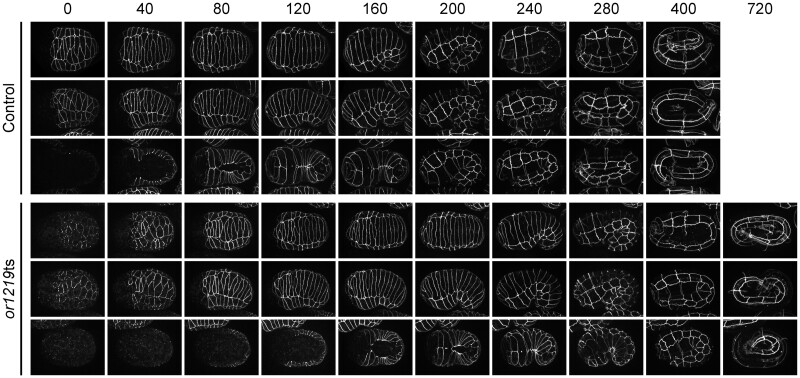
Figure 1 – extracted from the publication: or1219ts embryos have delayed development at the permissive temperature but still elongate. Maximum projection images of live control (top three rows) or mutant (or1219ts; bottom three rows) embryos, expressing DLG-1::GFP to mark epidermal cell membranes, kept at 15°C
Publication source
- Source of publication: G3
- Paper title: A Genetic Screen for Temperature-sensitive Morphogenesis-defective Caenorhabditis elegans Mutants
- Authorship: Molly C Jud, Josh Lowry, Thalia Padilla, Erin Clifford, Yuqi Yang, Francesca Fennell, Alexander K Miller, Danielle Hamill, Austin M Harvey, Martha Avila-Zavala, Hong Shao, Nhan Nguyen Tran, Zhirong Bao and Bruce Bowerman