Application notes

SCIENTIFIC POSTER — Charting new paths in adipose tissue organoid development via stromal fraction

Authors: Mathilde Cadoux, PhD; Emilie Ouanounou; Ghofrane Ben Messaoud; Hadhemi Mejri; Julius Elliot Nyegaard Grothen, PhD; Thomas Askov Pedersen, PhD; Dario Fassini, PhD

Metabolic diseases are strongly linked to adipose tissue dysfunction, yet current in vitro models poorly capture the biology of mature white adipose tissue.

In collaboration with Novo Nordisk, we optimized protocols to generate SVF-derived adipose organoids using Cherry Biotech’s CubiX microphysiological system. Our work focused on:

  • Developing SVF-derived
    organoids reproducing key features of white adipose tissue, including
    unilocular adipocytes and endothelial cells

  • Exploring perfusion and
    hydrogel effects on adipose organoid morphology, viability, and
    differentiation

  • Validating cryopreserved SVF as
    a robust source, enabling reproducible and physiologically relevant white adipose tissue models

Download our poster to discover how this model supports metabolic disease research and drug discovery.

In this study, CubiX has enabled precise control of oxygen, nutrients, and flow, supporting the advancement of more refined and reliable in vitro organoid models.

The poster, titled: Charting new paths in adipose tissue organoid development via stromal vascular fraction – is free to download here. Don’t miss out!
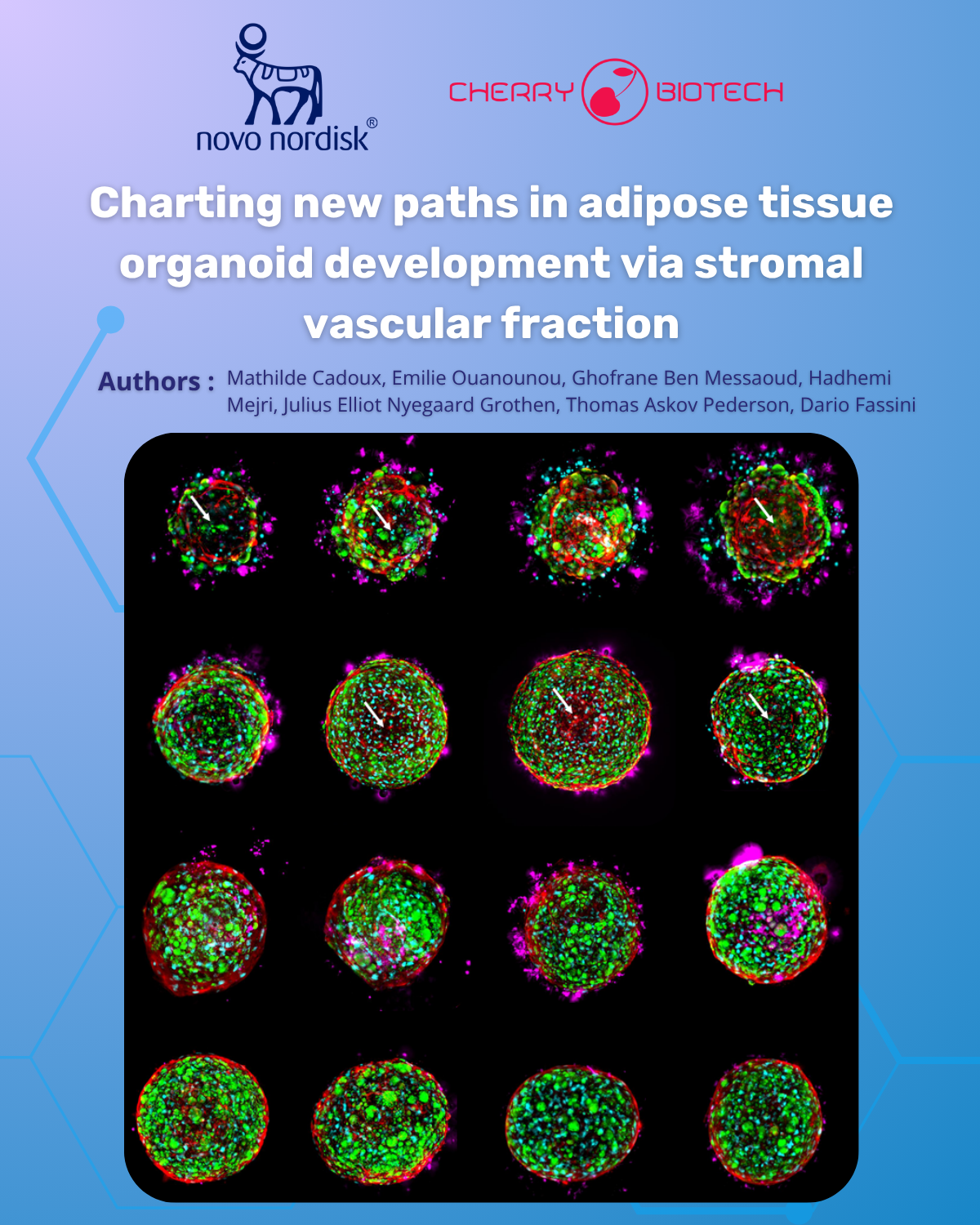
Poster featuring fluorescent microscopy images of human adipose tissue organoids derived from stromal vascular fraction (SVF). The images display spherical 3D organoids with green, red, and magenta fluorescence highlighting different cell populations and extracellular structures. Logos of Novo Nordisk and Cherry Biotech appear at the top, with the title “Charting new paths in adipose tissue organoid development via stromal vascular fraction” and a list of contributing authors.

SCIENTIFIC POSTER — Charting new paths in adipose tissue organoid development via stromal fraction

How to culture vascularized & immunocompetent 3D models in a standard Multiwell

Related Posts

From 2D to 3D cell cultures...
Why and how? From 2D to 3D cell cultures : The main issues found while using 2D cell systems, is that it is not possible to have access to t...
Read more
Illustration of a round clump of breast cancer cells being attacked by spiky immune cells and medication, representing a 3D breast cancer model used for drug testing.
A new era in preclinical testing: The 3D model for breast cancer ...
In oncological research, the development of a 3D model for breast cancer immunotherapies marks a pivotal shift from traditional preclinical ...
Read more
Human cells: Microfluidics as a tool for drug delivery...
Introduction The term “drug delivery” generally refers to the administration of a certain chemical compound to a biological system for t...
Read more

get in touch

Get the best insights about Cherry Biotech by Email Let’s stay in touch!
As part of our commercial prospecting, we may need to process your personal data. For more information, please consult our Privacy Policy
×

Our Associated Solutions

Banner

Need to quickly generate results? Our ready to use AdipoPlates are perfect for you!

Discover our AdipoPlate
×

Contact Us!

Aside

We're happy to answer any questions you may have. Reach out to our team for assistance.

Contact Now