C.elegans embryonic development uses redundant genes and are epigenetically shaped by parental adaptations to survive.
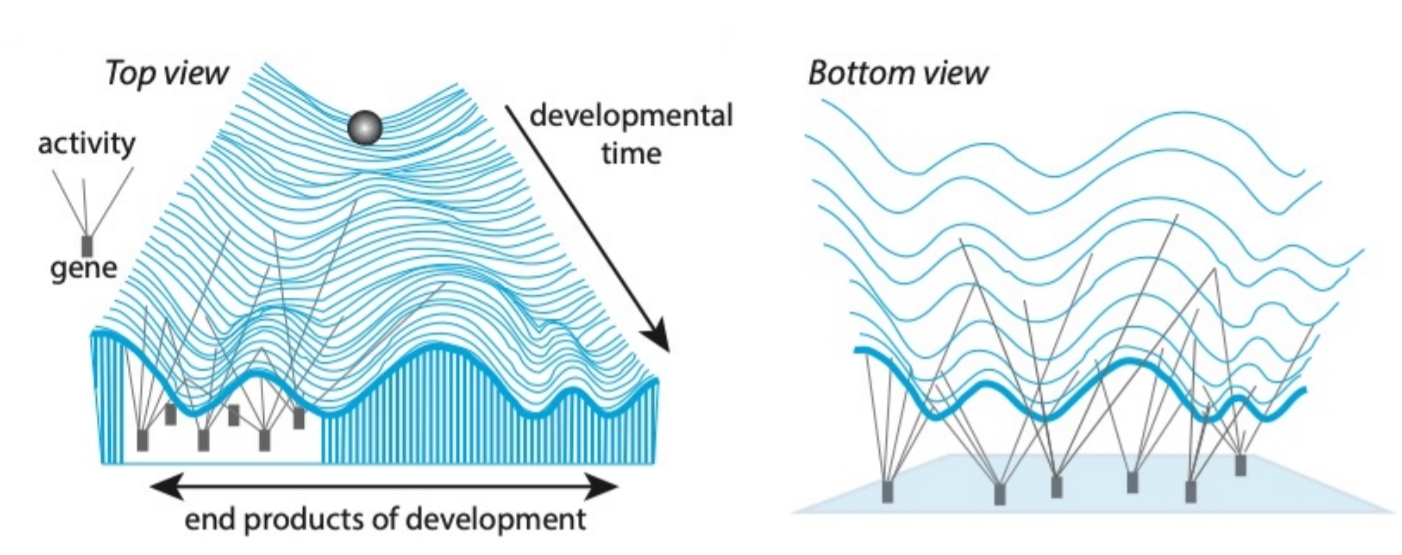
Conrad Hal Waddington (1905-1975) developed his “Waddington Epigenetic Landscape” model to explain the various pathways a cell can take to differentiate during embryonic development. Ahmed Elewa, working on C. elegans wanted to show the changes which occur depending on the environment during embryogenesis, and how they are linked to parental adaptations. Genes with the highest contributions to epigenetic tension in early stages are related to behaviour, stress response and transcription regulation, describes the researcher. This study also supports the idea that a deposit of parental RNA in early embryogenesis starts a robust development, as well as one adapted to the environment and epigenetically shaped by parental adaptations.
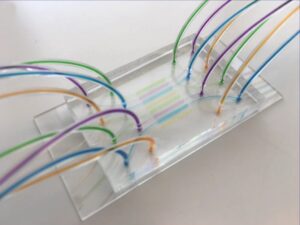
Ultra fast temperature shift device for in vitro experiments under microscopy
Abstract
Waddington’s Epigenetic Landscape provides a visual model for both robust and adaptable development. Generating and exploring a Waddington epigenetic landscape for the early C. elegans embryo suggests that the key shapers of the landscape are genes that lie at the nexus between stress response and behavior and include genes that are regulated by transgenerational neuronal small RNAs. Curiously, several genes shape the early landscape of one lineage and then pattern, differentiate or are enriched in another lineage. Additionally, paralogs with similar expression profiles contribute differently to shaping the modeled landscape. This work suggests that robust embryonic development is initialized by differential deployment of redundant genes and by transgenerational cues that configure the epigenetic landscape to adapt to a changing world.
References
FAQ
The "Waddington Epigenetic Landscape" is a concept developed by Conrad Hal Waddington. It was designed to explain the various pathways available to a cell during the differentiation process of embryonic development. The landscape is a visual model. It is used to show development that is both stable and flexible. In studies of C. elegans, this model was used by researchers. They wanted to show the changes that happen during embryogenesis. These changes are dependent on the environment. They are also connected to adaptations passed down from the parents. The model provides a way to visualize how different cell differentiation pathways are chosen.
The main shapers of the epigenetic landscape in the early C. elegans embryo have been identified. These are genes that are found at the intersection of stress response and behaviour. This group includes genes that are regulated by small RNAs passed down through neurons. A study described that the genes with the highest effect on epigenetic tension in early stages are related to these areas. These areas are behaviour, stress response, and the regulation of transcription. The work suggests that development is started by the differential use of these genes. Transgenerational cues are also involved. These cues configure the landscape, allowing it to adjust to a changing world.
Dependable embryonic development in C. elegans is achieved through several mechanisms. A deposit of parental RNA at the start of embryogenesis is thought to begin this stable development process. This deposit also ensures the development is suited to the environment. The development is also epigenetically shaped by adaptations from the parents. Work on the Waddington landscape suggests that this stable development is initialized by specific genetic actions. This involves the differential deployment of redundant genes. Transgenerational cues are also involved. These cues help configure the epigenetic landscape so the embryo can adjust to a changing world.
When generating the epigenetic landscape for C. elegans, other genetic behaviours were observed. It was noted that several genes shape the early landscape of one specific lineage. Later in development, these same genes are involved in a different function. They may pattern, differentiate, or be enriched in a completely different lineage. This shows a complex relationship between genes and cell fates over time. Another finding related to paralogs. Paralogs are genes that often have similar expression profiles. Despite this similarity, it was found that these paralogs contribute differently to shaping the modelled landscape. This indicates that even closely related genes can have distinct roles in the developmental process.