Introduction
According to a recent study headed by UT Southwestern researchers, increasing a protein contained in brown fat appears to lower blood sugar, enhance insulin sensitivity, and protect against fatty liver disease by remodeling white fat to a healthy condition.
The discovery, which was published online in Nature Communications, could eventually lead to new treatments for patients suffering from diabetes and related illnesses.
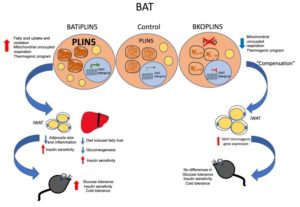
Bickel and his colleagues, including co-leader Violeta I. Gallardo-Montejano, M.D., an instructor at UTSW, discovered that brown fat may play a significant role in diabetes prevention. The researchers discovered this while examining perilipin 5 (PLIN5), a protein that coats lipid droplets inside cells, namely in Brown Adipose Tissue (BAT).
However, these cutting-edge findings have been demonstrated in mouse models, a confirmation in human physio-mimetic environment will be key to extrapolate such results into clinical trials.
How to culture vascularized & immunocompetent 3D models in a standard Multiwell
Abstract of Perilipin 5 links mitochondrial uncoupled respiration in brown fat to healthy white fat remodeling and systemic glucose tolerance
The authors state that “Exposure of mice or humans to cold promotes significant changes in brown adipose tissue (BAT) with respect to histology, lipid content, gene expression, and mitochondrial mass and function. Herein we report that the lipid droplet coat protein Perilipin 5 (PLIN5) increases markedly in BAT during exposure of mice to cold. To understand the functional significance of cold-induced PLIN5, we created and characterized gain- and loss-of-function mouse models.
Enforcing PLIN5 expression in mouse BAT mimics the effects of cold with respect to mitochondrial cristae packing and uncoupled substrate-driven respiration. PLIN5 is necessary for the maintenance of mitochondrial cristae structure and respiratory function during cold stress.
We further show that promoting PLIN5 function in BAT is associated with healthy remodeling of subcutaneous white adipose tissue and improvements in systemic glucose tolerance and diet-induced hepatic steatosis. These observations will inform future strategies that seek to exploit thermogenic adipose tissue as a therapeutic target for type 2 diabetes, obesity, and nonalcoholic fatty liver disease.”
References
Gallardo-Montejano, V.I., Yang, C., Hahner, L. et al. Perilipin 5 links mitochondrial uncoupled respiration in brown fat to healthy white fat remodeling and systemic glucose tolerance. Nat Commun 12, 3320 (2021). https://doi.org/10.1038/s41467-021-23601-2
FAQ
Perilipin 5, or PLIN5, is a protein. It is described as a lipid droplet coat protein. Its function is to coat these droplets inside cells. It is found particularly in Brown Adipose Tissue, also known as BAT. Research in mice has shown that exposure to cold promotes significant changes in BAT. One of these changes is that the PLIN5 protein increases markedly in the brown fat. This protein was examined by researchers to understand its role.
The functional significance of the cold-induced increase in PLIN5 was studied using mouse models. It was found that enforcing the expression of PLIN5 in mouse brown adipose tissue (BAT) copied the effects of cold. These effects were specifically related to mitochondrial cristae packing. They were also related to uncoupled substrate-driven respiration. The protein was also found to be necessary during cold stress. PLIN5 is required for maintaining the mitochondrial cristae structure. It is also needed for respiratory function.
Promoting the function of PLIN5 in brown adipose tissue (BAT) was associated with several systemic effects in mouse models. A study indicated that increasing this protein appears to lower blood sugar. It also seems to enhance insulin sensitivity. The research showed an association with the healthy remodeling of subcutaneous white adipose tissue. This remodeling of white fat to a healthy state may protect against fatty liver disease. Improvements were seen in systemic glucose tolerance. Diet-induced hepatic steatosis, or fatty liver, was also improved.
This discovery could eventually lead to new treatments. These treatments would be for patients who suffer from diabetes and related illnesses. The observations from this research will inform future strategies. These strategies would seek to use thermogenic adipose tissue as a therapeutic target. The targeted conditions include type 2 diabetes, obesity, and nonalcoholic fatty liver disease. It is noted, however, that these findings have been demonstrated in mouse models. A confirmation in a human physio-mimetic environment will be a key step to extrapolate these results into clinical trials.